Oklahoma license plates come in one rear tag per vehicle, a month and year decal, and a design that changed on 1 September 2024. Drivers deal with Service Oklahoma instead of a DMV office for titles, tags and registration paperwork. This page covers every plate category, the fees tied to each one, the renewal calendar and the mounting rules that decide where a plate may sit. Figures come from Service Oklahoma fee schedules and Title 47 of the Oklahoma Statutes, checked on the date below.
Oklahoma license plates reward a little planning. A buyer who knows the excise rate, the title fee and the age-based registration scale can estimate the out-the-door cost before a tag agency visit. A seller who keeps the metal plate for the next vehicle avoids a replacement charge. The sections below follow the order most drivers meet these tasks: what the plate looks like, which type fits the vehicle, what each costs, how to obtain or renew it, and where the legal limits sit on lookup and display.
What an Oklahoma License Plate Looks Like Today
Two standard designs share the road right now. The older tag shows a scissor-tailed flycatcher against blue mountains, and the newer tag uses a red background with white characters. Both remain valid, and neither must be swapped until the owner chooses to pay for the new artwork.
The Iconic Oklahoma Plate of 2024
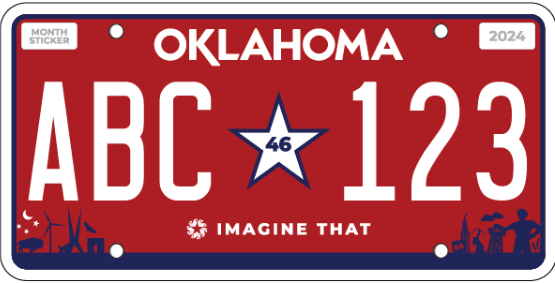
Service Oklahoma released the red design on 1 September 2024. It carries a white serial number, a 46-star icon drawn from the original state flag, and small blue landmarks along the bottom: the Skydance Bridge, the Oklahoma City Memorial, Route 66, the Sacred Rain Arrow statue, a wind turbine, wheat, an American bison, a red-tailed hawk and the Golden Driller. Freestyle Creative, an Oklahoma City studio, drew the artwork.
Who Gets the New Plate
The state does not mail the new design to every registered owner. A driver who wants it pays a $4 plate replacement charge during an annual renewal, or $9 outside a renewal window at a licensed operator. Vehicles registered for the first time receive whichever standard stock the agency holds, and the older flycatcher tag stays legal on any vehicle that already carries one.
Size, Mounting and Decals
Every passenger plate measures 12 inches by 6 inches and is stamped from aluminum. Oklahoma has required only a rear plate since 1944, so a front bracket is optional. A decorative front plate is legal when it does not block the view of the road or copy an official design.
Decals and Legibility
The registration decal sits in the upper right corner of the rear plate and shows the month and year of expiration. Troopers check that decal during a stop, and a missing or obscured decal can be treated as an unregistered vehicle. Plates must stay clean enough to read from a patrol car, which rules out heavy mud, tinted covers and frames that hide the state name or the serial.
Serial Patterns You Will See
Standard passenger tags use three letters followed by three digits, written ABC-123. The current series began at PZJ-001 and moves forward as new plates are stamped. Older six-character layouts such as 123-ABC remain on the road, and a seven-character format with four digits appears on some newer issues.
Personalized and Tribal Formats
Personalized tags break the pattern on purpose. A driver may order one to seven letters, seven digits, or a mix of letters and numbers, with a hyphen or a space as the only allowed separator. Tribal plates, commercial tags and motorcycle tags each carry their own prefix, so a plate number alone does not always identify the vehicle class.
Types of Oklahoma License Plates
Service Oklahoma groups plates into a standard issue tag and a long catalog of specialty designs. The catalog splits into military, education, tribal, civil service, special interest and fund-raising categories. Each entry carries its own eligibility test, fee and application form, so a driver checks the category before ordering.
Standard Issue Plates
The standard tag arrives with a first registration or a title transfer and carries no extra charge beyond the normal registration fee. A damaged or lost standard plate costs $9 to replace, plus a $1.50 insurance verification charge and a mail fee when the request goes by post. A driver may request a fresh standard plate at renewal for the $4 redesign charge.
Specialty Plates
Specialty tags support a school, a branch of service, a tribe or a cause. Most university and organizational designs cost $41.60 for the first issue and $36.66 at each renewal, but a smaller group of plates costs $21.60 and $16.66. The money above the standard registration fee goes to the organization named on the application.
New Specialty Designs
New designs enter the catalog through the legislative session. A plate authorized in 2026 needs 100 prepaid applications on file by 30 October 2026 before the state orders a production run, and manufacturing takes six to eight months after approval. Applications go on Form 708-E for new designs, with separate forms for military, fraternal, tribal and collegiate plates.
Popular Specialty Designs
Popular entries in the current catalog include the Ducks Unlimited tag, the Tulsa Zoo design, Save the Monarchs, the State Parks pavilion plate, the Oklahoma Blood Institute tag and the Route 66 Centennial plate authorized in 2026. A driver picks a design at the agency, completes the matching application, and pays the first-issue fee with the standard registration in one transaction. Some plates need proof of membership, a military record or a tribal card before the order moves forward.
Personalized Plates
A personalized tag carries the driver’s own characters on a plain background. Form 749 sets the rules: no more than seven characters, no punctuation beyond a hyphen or space, and a review that rejects combinations offensive to the general public. Six background colors are offered: white, silver gray, sand, sea green, chamois and sky blue.
Personalized Plate Fees
The order fee runs $26.60, which includes a $20 plate charge and a $6.60 mail charge, and renewal costs $21.66. Production takes four months at the state plant, and agency staff often quote 12 to 16 weeks. The flycatcher artwork is not offered on a personalized plate, and a personalized plate belongs to the person who ordered it rather than to the car.
Tribal Plates
The Chickasaw Nation and the Choctaw Nation both issue tags through Service Oklahoma. An applicant supplies a tribal membership statement on the title or a Bureau of Indian Affairs card, plus the usual registration documents. A personalized tribal plate costs $26.60 to order and $21.66 to renew, and a disability version carries a lower rate for the first plate.
Tribal Plate Rules
Tribal tags cannot be sold to a registrant with an out-of-state address. The only exception covers an Oklahoma resident on active duty stationed elsewhere. The Cherokee Nation and several other tribes run their own tag offices under compact agreements, so a driver may handle registration at a tribal office instead of a state licensed operator.
Disability, Military and Antique Plates
A physically disabled plate requires a current five-year parking placard from the Department of Public Safety. Military tags cover service branches, campaigns and decorations such as the Purple Heart and Gold Star, and most require a DD-214 or a Veterans Affairs letter. Antique and classic tags use Form 763 for a classic vehicle and Form 750-A for a vintage registration, each with its own mileage and use limits.
What Plates and Registration Cost
Oklahoma charges three separate amounts at a tag agency: the annual registration fee, a title fee on a change of ownership, and excise tax on the purchase price. A plate order or a replacement sits on top of those figures. The total depends on the vehicle, the price paid and the county where the buyer registers.
Annual Registration by Vehicle Age
The registration fee drops as a vehicle ages. A new passenger car starts at $96 for the first year, then falls by roughly $10 a year until it reaches a floor of $26, which applies to older vehicles. The scale is set in statute and applies to the model year of the vehicle, not to the date the owner bought it.
| Vehicle year on the road | Annual registration |
|---|---|
| 1st year | $96 |
| 2nd year | $86 |
| 3rd year | $76 |
| 4th year | $66 |
| 5th year | $56 |
| 6th year | $46 |
| 7th year | $36 |
| 8th year and older | $26 |
Commercial trucks, farm vehicles and motorcycles follow separate schedules. A driver who registers for two years pays the fee for each year at once, and the registration still expires in the same month of the second year. Motorcycles sit on the lowest scale, and farm trucks follow a weight-based schedule.
Title, Excise Tax and Agency Charges
A title costs $11. Excise tax on a purchase runs 3.25% of the price paid, and a city or county sales tax of up to 1.25% can apply on the same transaction. A trade-in reduces the taxable amount when the dealer documents it on the bill of sale.
Agency and Mailing Charges
Some agencies charge an owner-change fee of about $17 and a small notary charge when a signature needs witnessing. Insurance verification adds $1.50 on a registration or replacement transaction. Mailing a plate or decal adds $1.73 for a decal alone and $6.60 when a metal plate ships with it.
Paying at the Agency
Most agencies take cash, a debit card or a credit card, and a few add a service fee for card payments. A check or money order goes to Service Oklahoma when an application is mailed, and the driver license number must appear on the check. One visit can cover the registration, the title application and a plate order, so a single payment handles all three items.
Specialty, Personalized and Replacement Fees
| Item | First issue | Renewal |
|---|---|---|
| Standard plate | No extra charge | No extra charge |
| Personalized plate (Form 749) | $26.60 | $21.66 |
| University and organizational specialty | $41.60 | $36.66 |
| Lower-tier specialty plate | $21.60 | $16.66 |
| Tribal personalized | $26.60 | $21.66 |
| Replacement plate or decal | $9 plus $1.50 insurance | Not applicable |
A specialty or personalized plate carries the standard registration fee at the same time. Oklahoma law requires both amounts in one payment, and the agency surrenders the old standard plate when the specialty tag arrives. Agency staff collect both amounts in one transaction.
Getting a Plate and Keeping It Current
The steps differ for a dealer purchase, a private sale, an annual renewal and a move from another state. Each route ends at a licensed operator, the network of private tag agencies that handle state motor vehicle work. A buyer who knows the deadline for each step avoids a second trip.
Buying From a Dealer
A dealer submits pre-registration data to Service Oklahoma within two business days of the sale and hands the buyer a 10-day paper tag. The chosen licensed operator mails a metal plate with two pre-registration decals, and the buyer must mount that plate within ten days of the purchase date. The buyer then has two months to complete full registration, pay excise tax and collect the title. A buyer who keeps a plate from the previous vehicle receives decals only, since the old metal plate moves to the new car at titling.
Private Sales and Pre-Registration
In a private sale, either the buyer or the seller files the pre-registration on the Navigate portal within two business days. The filing names the licensed operator who will mail the plate and decals, and the buyer confirms the details by email when the seller submits the form. A buyer who prefers a counter visit can pre-register in person at a tag agency within the same two-day window and leave with the plate and decals. The ten-day mounting deadline applies either way, and the two-month window for full registration starts on the sale date.
Renewal and Late Charges
Service Oklahoma mails a renewal notice before the expiration month. A driver can renew at any licensed operator, by mail, or through the online renewal channel. The plate, the registration receipt and the decal all carry the same expiration date, and the new decal goes over the old one in the upper right corner.
Late Renewal Penalties
Registration expires at the end of the assigned month. A renewal that arrives after that date collects a penalty from the first day of the following month, and the penalty grows the longer the vehicle stays unregistered. A vehicle with a lapsed tag can be towed, and driving one can bring a citation on top of the back fees.
Specialty Plate Renewal
Specialty and personalized plates renew on the same schedule as the standard registration. The agency consolidates the specialty plate with the standard registration and takes the standard metal plate back, so the specialty tag becomes the only plate on the car. The agency takes the standard metal plate back at the same visit.
Moving to Oklahoma
A new resident has 30 days to register a vehicle. The process needs an out-of-state title, proof of Oklahoma insurance, a VIN inspection and the usual fees. A lienholder who holds the title can send a copy or an electronic title record, and the agency works from that document.
Military and Student Plates
Military members stationed in Oklahoma follow the same 30-day rule, except when their home state keeps the registration active. A student who moves here for school and keeps a parent’s address in another state usually keeps the out-of-state plate, though insurance rules still apply. An active-duty member who registers here pays the same fees as any other resident.
Plate Lookup and Privacy
Oklahoma does not publish a public database that turns a plate number into an owner name. The Driver’s Privacy Protection Act, 18 U.S.C. 2721, restricts personal information held by a motor vehicle agency, and Service Oklahoma releases records only for a permissible purpose such as a law enforcement stop, a toll bill, an insurance claim or a court order.
What a Paid Report Shows
A paid lookup service works from a plate number to a vehicle identification number, then pulls a history report from NMVTIS and partner data. That report can show title brands, salvage or rebuilt status, odometer readings, reported accidents and auction records. It cannot show an owner name, a home address or a phone number, and a site that promises those details is either misrepresenting the product or breaking the law.
What a Free Search Returns
A free search usually returns the make, model, year and open safety recalls. That data comes from public vehicle records and NHTSA, not from a registration file. A buyer who needs a full history should order the NMVTIS report through an approved provider and compare the VIN on the report with the VIN stamped on the dash and the door jamb.
Laws Drivers Ask About
Oklahoma requires one plate on the rear of a passenger vehicle. A front plate is not issued and not required, and a decorative front tag is fine when it stays clear of the windshield view and does not mimic a state design. The rear plate must sit in the factory location, not on the dashboard.
Mounting, Frames and Covers
Plates must be mounted in the factory location, lit by a white light at night, and kept free of covers that reduce legibility. A frame may not hide the state name, the serial or the registration decal. Tinted or smoked covers draw citations, since a camera or a trooper cannot read the characters through them. Mud, snow and tow-hitch racks count as obstructions when they hide the characters.
Plates Belong to the Owner
Since 1 July 2019 a plate belongs to the person rather than to the vehicle. An owner who sells a car keeps the metal plate and may move it to the next vehicle when that vehicle is titled. A plate that is lost or stolen gets reported to the agency and replaced with Form 797-D, an affidavit that states the plate is no longer usable.
Penalties and Seizure
Driving with an expired tag, a missing plate or a plate seized for an insurance lapse carries separate penalties. A plate seized under the compulsory insurance law stays with the county sheriff until the fines are paid and a release is issued, and the agency will not print a replacement before that release arrives. A citation for an expired tag adds to the back fees rather than replacing them.
A Short History of Oklahoma Plates
Oklahoma first required vehicle registration in 1915, and the state issued its earliest tags that same year. Only a rear plate has been required since 1944, a rule that still holds. County codes and staggered monthly registration arrived in the decades that followed, and the state moved to a single statewide series in 2009.
Design Changes Since 1989
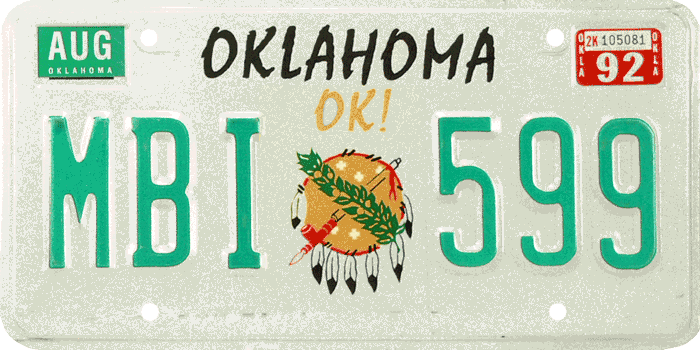
The 1989 design carried the Osage Nation battle shield and won Plate of the Year from the Automobile License Plate Collectors Association. The 2009 tag moved to a screened flat plate with Allan Houser’s Sacred Rain Arrow sculpture, and it took the same award. The 2017 tag introduced the scissor-tailed flycatcher over a blue mountain scene with the Explore Oklahoma line, and the 2024 red plate replaced it with the state brand artwork.
Collecting Oklahoma Plates
Collectors sort Oklahoma tags by manufacturing method as much as by design. Embossed plates ran through 2008, flat screened plates began in 2009, and the state has replaced the full stock twice since then. A clean 1989 shield plate or an early 2009 arrow plate sells for more than a common 1990s tag, and a plate still attached to its original registration paperwork draws the strongest bids. The Automobile License Plate Collectors Association has named an Oklahoma design plate of the year four times, most recently for the 2020 Save the Monarchs tag.
Official sources
- Service Oklahoma, License Plates: https://oklahoma.gov/service/popular-services/license-plates.html
- Service Oklahoma, New and Used Vehicle Registration: https://oklahoma.gov/service/all-services/auto-vehicle/new-used-vehicle-registration.html
- Oklahoma Statutes, Title 47: https://www.oscn.net/applications/oscn/Index.asp?ftdb=STOKST47
Frequently Asked Questions
These answers cover the questions drivers ask most about Oklahoma plates, from the front-plate rule to the cost of a first registration. Each answer points back to the section above that explains the process in full, and the official source list holds the current form or fee for anything that changes.
Do I need a front plate in Oklahoma?
No. The state issues one plate for the rear of a passenger vehicle, and has done so since 1944. A decorative front plate is allowed if it does not block the driver’s view or copy an official design. A plate from another state comes off once the vehicle is registered here, and the old tag goes back to that state’s agency.
How much does it cost to register a car in Oklahoma?
A first-year passenger registration runs $96, then falls each year to $26 for older vehicles. Add $11 for a title, 3.25% excise tax on the purchase price, $1.50 for insurance verification, and any agency or mail charge. A used car bought for $10,000 carries about $325 in excise tax before the tag fee is added.
Can I keep my Oklahoma plate when I sell the car?
Yes. Since 1 July 2019 the plate belongs to the owner, not the vehicle. Keep the metal plate and move it to the next car when that car is titled, or surrender it to a licensed operator. A plate that is not transferred should go back to the agency so the old registration record closes.
How long does a personalized plate take?
The state plant quotes about four months, and agencies often tell buyers 12 to 16 weeks. Form 749 allows up to seven characters and six background colors, and the order fee is $26.60. The new plate keeps the expiration month of the registration it replaces, so the renewal date does not move.
Can I look up the owner of an Oklahoma plate?
No. Federal privacy law blocks release of owner details from a registration file. A paid report can confirm the vehicle, its title history and its recall status, but not a name, address or phone number. A request outside a permissible purpose needs a court order served on Service Oklahoma.