Oklahoma license plate options fall into three groups: the standard issue tag, the specialty catalog and the personalized plate. Service Oklahoma issues each type through licensed operators across the state, and each carries its own eligibility test and fee. Some designs need a military record or a tribal card, and others need nothing beyond a current registration. This page maps the full catalog, shows who qualifies for each category, lists the fees and names the page that explains each type in detail.
Oklahoma license plate options share one rear-mounting rule, one registration cycle and one renewal calendar. The plate type changes the artwork, the fee and the paperwork, not the month the tag expires. A driver who picks a specialty design still pays the standard registration fee for the vehicle at the same counter visit. Fees below come from Service Oklahoma schedules, and each category has its own page with the full process and the counter step for a first order at a licensed operator.
How Oklahoma Organizes Plate Categories
Service Oklahoma sorts every plate into a standard issue tag, a specialty design or a personalized order, and the state record treats the three the same way. The standard tag carries the state serial and no extra plate fee, and a specialty design supports an organization with a set surcharge. A personalized tag prints characters the owner chooses on a plain background. A driver moves between the groups at renewal without a new title, and the registration receipt stays valid through the change.
The Three Groups Compared
Standard issue covers the plate a vehicle receives with a first registration or a title transfer. Specialty covers the long catalog of organizational, military, tribal and cause designs, and each entry carries an eligibility rule. Personalized covers the owner’s own characters, which the state reviews before stamping. A vehicle holds one of the three at a time, since Oklahoma issues a single rear plate for a passenger car, so a shopper who weighs oklahoma car tag options starts from the same short list.
Eligibility and Proof at the Counter
Each category names the proof a clerk must see before the application moves. A military tag needs a DD-214 or a Veterans Affairs letter, a tribal tag needs a membership document or a Bureau of Indian Affairs card, and a disability plate needs a current placard. Organizational plates often need a membership card or a signed statement from the group. The Oklahoma specialty plates page covers this step in more detail. The clerk attaches the proof to the application and keeps a copy in the agency file for later renewals and audits.
How the Catalog Is Published
The full list sits on the Service Oklahoma specialty plate page, sorted by category with a sample image for each design, and a search for oklahoma licence plate options leads to the same state pages. New entries arrive after the Legislature authorizes a plate and the state collects 100 prepaid applications by 30 October 2026. Production of a new design takes six to eight months after that threshold is met. The state form page carries the current application for each group, and the agency counter holds paper copies at no charge.
| Category | Who qualifies | First-issue fee | Detail page |
|---|---|---|---|
| Standard issue | Any registered vehicle | No surcharge | Standard plate page |
| Specialty | Member or supporter of the group | $41.60 or $21.60 | Specialty plates page |
| Personalized | Owner with a current registration | $26.60 | Personalized plates page |
| Tribal | Enrolled tribal member | $26.60 personalized | Tribal plates page |
| Disability | Driver with a certified condition | Standard fee | Disability plates page |
| Antique or classic | Vehicle 20 or 25 years old | Reduced fee | Antique plates page |
| Motorcycle | Registered motorcycle | Lowest scale | Motorcycle plates page |
Standard Issue Plate
The standard plate arrives with a new registration, a title transfer or a move from another state, and it carries no plate surcharge. It shows a three-letter, three-digit serial from the current PZJ series on aluminum stock stamped at the state plant. Oklahoma makes it 12 inches by 6 inches and requires it on the rear only. A driver keeps the same plate through renewals until it wears out or the owner asks for the 2024 design, and the serial stays with the car.
What Comes With a First Registration
A first registration produces the metal plate, a month and year decal and a registration receipt. The receipt carries the plate number, the expiration month and the fee breakdown for the transaction. The decal goes in the upper right corner of the rear plate, over any older sticker, and marks the year ahead. A reader can check the personalized license plate page before the visit. A driver should check that the serial on the receipt matches the stamping on the plate before leaving the counter.
The 2024 Red Design
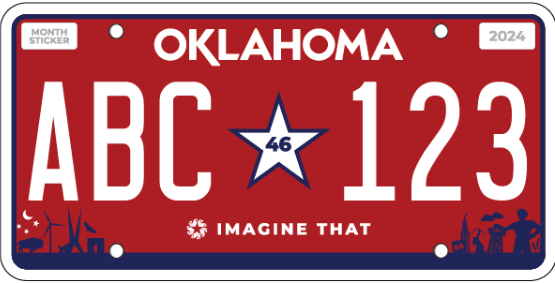
Service Oklahoma released the red Iconic Oklahoma plate on 1 September 2024, and it shows a white serial against a red field. A 46-star icon and small state landmarks run along the lower edge of the design. The state does not mail the new plate to every registered owner. A driver pays $4 to swap during a renewal or $9 outside a renewal window, and the older flycatcher tag stays legal on any car that still carries one.
Replacement, Loss and Surrender
A lost, stolen or damaged plate goes through a short replacement process, and the affidavit states that the old plate is no longer usable. Form 797-D carries that statement. The agency prints a new plate with a fresh serial, and only a personalized or specialty design keeps its old characters. A surrendered plate goes back to the operator, which marks the record closed and issues a dated receipt at the counter. The table below lists what the visit costs.
| Standard plate item | Charge |
|---|---|
| First standard plate | No extra charge |
| 2024 design swap at renewal | $4 |
| 2024 design outside renewal | $9 |
| Replacement plate or decal | $9 |
| Insurance verification | $1.50 |
| Mailed metal plate | $6.60 |
| Mailed decal only | $1.73 |
Specialty Plate Categories
The specialty catalog splits into military, education, tribal, civil service, special interest and fund-raising groups. Most designs cost $41.60 on the first issue and $36.66 at renewal, and a smaller tier costs $21.60 and $16.66. The amount above the standard registration fee goes to the organization named on the application. Figures for this step sit on the Oklahoma tag cost page. Each group carries its own form, its own proof requirement and its own line in the state catalog, so a buyer checks the group before filing.
Military Plates
Military tags cover the Army, Navy, Air Force, Marine Corps, Coast Guard and Space Force, plus campaign and decoration plates such as the Purple Heart and Gold Star. An applicant supplies a DD-214, a retirement order or a Veterans Affairs letter at the counter. A spouse or a surviving family member may qualify for certain designs under the same proof rule. The finished plate carries the branch emblem and a serial, and it renews on the normal registration cycle each year.
Education and Collegiate Plates
University plates cover Oklahoma, Oklahoma State, Tulsa, Central Oklahoma and most other state schools, and each design shows the school name. A buyer does not need a diploma, since the plate is open to any registered owner who pays the fee. The money above the registration charge supports the school’s scholarship fund and its alumni programs. A few education designs honor a named program, and those carry their own eligibility line on the application form at the agency.
Tribal Plates
The Chickasaw Nation and the Choctaw Nation issue tags through Service Oklahoma, and the Cherokee Nation runs its own tag offices under a compact. An applicant shows a tribal membership statement on the title or a Bureau of Indian Affairs card before the order moves. A personalized tribal plate costs $26.60 to order and $21.66 to renew. Tribal tags cannot go to an out-of-state address except for an Oklahoma resident on active duty.
Civil Service and Fraternal Plates
Civil service designs honor veterans of a branch, firefighters, paramedics and law enforcement officers. A fraternal group such as the Masons or the Shriners may hold a design of its own. Each needs a department letter, a union card or a lodge statement before the order moves forward. The agency files the proof with the application, and the fee follows the standard specialty tier for the design.
Special Interest Plates
Special interest covers the largest slice of the catalog: wildlife, sports teams, hobbies, health charities and state landmarks. Designs include Ducks Unlimited, the Tulsa Zoo, Save the Monarchs, the State Parks pavilion and the Route 66 Centennial plate authorized in 2026. Most need no proof beyond a current registration. A few require a membership number, which the group supplies when the driver joins.
Fund-Raising Plates
A fund-raising plate sends its surcharge to a named trust, foundation or state program. The Oklahoma Blood Institute tag, the breast cancer awareness plate and the wildlife diversity design work this way. The organization receives the amount above the standard registration fee after the state covers production. A driver can ask the agency which fund a design supports before ordering a plate.
Fee Tiers and Production
Two fee tiers apply across the specialty catalog, and the catalog states which tier each design uses. A new design needs a set number of prepaid applications by the autumn deadline before the state orders a run, and production then takes several months. Form 708-E carries a new-design request, with separate forms for military, fraternal, tribal and collegiate plates. The table below shows how the two tiers compare.
| Design group | Proof at the counter | First issue | Renewal |
|---|---|---|---|
| Military | DD-214 or VA letter | $41.60 | $36.66 |
| Collegiate | Current registration | $41.60 | $36.66 |
| Tribal personalized | Membership paper or BIA card | $26.60 | $21.66 |
| Civil service | Department or lodge letter | $41.60 | $36.66 |
| Special interest | None or a membership number | $41.60 or $21.60 | $36.66 or $16.66 |
| Fund-raising | None | $41.60 | $36.66 |
Personalized Plates in Brief
A personalized plate puts the owner’s characters in place of the state serial, and Form 749 governs the request. The state allows seven characters and one background from a set of six colors. The character review, the availability search and the counter steps belong to the personalized plates page. This section covers the category, the fee and the wait so a driver knows where the detail sits.
The Character and Color Rules
Seven characters is the maximum, and a hyphen or a space is the only separator the state accepts. The review refuses profanity, slurs, drug references and strings that mimic a law enforcement or agency tag. Six background colors carry the chosen characters in a contrasting tone. A motorcycle owner files Form 746 instead of Form 749.
Cost and Production Wait
The first order costs $26.60, made up of a $20 plate charge and a $6.60 mail charge, and a renewal costs $21.66. Production takes 12 to 16 weeks, and the current plate stays on the car during that stretch. The plate belongs to the owner, so it may move to a replacement vehicle at titling. The expiration month does not change.
What This Page Leaves Out
The character review, the availability search and the counter steps sit on the personalized page, which covers Form 749 in full. This page keeps to the category, the fee and the wait. A driver who wants chosen characters on a specialty background should ask the clerk whether that design accepts personalization. Most specialty designs do not, and the clerk can confirm before payment.
Disability Plates and Placards
Oklahoma issues a disabled plate or a parking placard to a driver with a qualifying condition certified by a licensed physician. The plate carries the international wheelchair symbol and replaces the standard tag. A placard hangs from the rear-view mirror and moves between vehicles. Both need a current certification, and both come up for renewal on a five-year cycle at a licensed operator.
Who Qualifies
A driver qualifies with a condition that limits walking to 200 feet, a lung or heart condition, a loss of a limb or a vision limit that bars driving without a device. A physician signs the certification on the state form. The agency reviews the statement and issues the plate or placard. A temporary placard covers a short recovery period and carries a printed end date.
The Disabled Plate
The disabled plate carries the wheelchair symbol and the vehicle serial. It replaces the standard rear plate, and the driver pays the standard registration fee with no plate surcharge in most cases. A personalized version is available at the usual personalized rate. The plate follows the vehicle to a new owner only when that owner holds a valid certification.
Placard Display and Renewal
A placard hangs from the rear-view mirror when the vehicle is parked and comes down when it is driven. The plate stays mounted in the factory location at all times. Both carry an expiration date, and renewal needs a fresh physician statement every five years. A lost placard is replaced at a licensed operator with a signed affidavit.
Antique, Classic and Vintage Plates
Oklahoma sets separate categories for antique, classic and vintage vehicles. Each carries a use limit and a different application. An antique tag suits a car kept for shows and occasional drives, a classic tag covers a vehicle 20 years old or more, and a vintage registration pairs a restored plate with a modern sticker. The fee differs by category, and the agency checks the model year before issuing a tag.
Antique Registration
An antique vehicle is 25 years old or older and kept for exhibitions, parades and occasional transport. The owner pays a reduced registration and accepts a mileage limit. A daily driver does not qualify, and the agency can ask for proof of the model year. The plate carries a special design, and the agency records the limited-use status on the registration.
Classic and Vintage Tags
Form 763 carries a classic plate request for a vehicle that is at least 20 years old and kept in original or restored condition. Form 750-A covers a vintage registration, which lets an owner display a restored plate of the same year as the vehicle with a state sticker. The state checks the plate number against the record. A vintage plate that duplicates an active serial is refused.
Use Limits and Mileage
Both categories restrict driving to club events, parades, displays and repair trips. A commute or a daily errand falls outside the allowed use. An owner who drives the vehicle to work risks a citation and a registration review. The agency may ask for a mileage statement at renewal, and a vehicle that exceeds the limit moves to a standard registration.
Papers for an Older Vehicle
A classic or antique application needs the title, proof of insurance, a photo of the vehicle and the plate if one is being reused. The agency confirms the year and the serial before issuing the tag. A vehicle brought in from another state needs a VIN inspection first. The owner should keep the registration receipt in the car during a show season.
Motorcycle and Other Vehicle Classes
Plate rules shift with the vehicle class, and the oklahoma tag options below cover the classes that sit outside the passenger schedule. A motorcycle carries one smaller rear plate, a commercial truck carries a weight-based tag, and a trailer carries a registration of its own. Farm vehicles, fleet accounts and apportioned carriers each follow a separate schedule. The standard registration table does not apply to these classes, so a driver checks the schedule before estimating a cost.
Motorcycle Plates
A motorcycle plate measures smaller than a passenger tag and mounts on the rear fender. The registration sits on the lowest fee scale in the state schedule. A personalized motorcycle tag uses Form 746, and the seven-character rule still applies. A rider who adds a specialty design pays the specialty tier on top of the motorcycle registration.
Commercial Trucks and Farm Tags
A commercial truck registers by declared weight, and the fee rises with each weight bracket. A farm tag costs less and limits the vehicle to farm use within a set radius. An owner who uses a farm truck for general hauling must move it to a commercial registration. The agency checks the declared use at the counter and records it on the title.
Trailers and Travel Trailers
A trailer carries a plate and a registration of its own, tied to the trailer identification number rather than to the tow vehicle. A travel trailer follows the same rule, so a buyer registers it separately from the truck. A small utility trailer under the state weight threshold may be exempt. The agency confirms the rule for the trailer class before a first registration.
Fleet and Apportioned Registrations
A business with several vehicles may hold a fleet account, which consolidates renewals under one record. An apportioned registration covers a carrier that runs in several states and splits the fee by miles traveled in each. Both routes need an International Registration Plan account and a monthly distance report. A dealer uses a separate series for vehicles held in inventory, and that tag does not transfer to a buyer.
Official sources
- Service Oklahoma, License Plates: https://oklahoma.gov/service/popular-services/license-plates.html
- Service Oklahoma, Specialty Plates: https://oklahoma.gov/service/all-services/auto-vehicle/specialty-plates.html
- Service Oklahoma, Forms: https://www.oklahoma.gov/service/all-pages/form.html
Frequently Asked Questions
These answers cover the questions drivers ask most about plate categories in Oklahoma, from the standard tag to a tribal or antique design. Each answer names the fee or the rule that decides the order, and the official source list holds the current form for anything that changes. A clerk at a licensed operator can confirm a figure before payment.
How many plate categories does Oklahoma issue?
Service Oklahoma groups plates into standard issue, specialty, personalized, tribal, disability, antique or classic and motorcycle classes. A specialty plate splits further into military, education, civil service, special interest and fund-raising designs. A vehicle carries one plate at a time, and each category has its own form and fee.
What is the difference between a specialty and a personalized plate?
A specialty plate carries a design tied to a school, tribe, branch of service or cause, and most cost $41.60 on the first issue. A personalized plate carries characters the owner chooses on a plain background for $26.60. A specialty plate may need proof of membership, and a personalized plate needs only a current registration.
Which plates need proof of eligibility?
Military plates need a DD-214 or a Veterans Affairs letter, tribal plates need a membership document or a Bureau of Indian Affairs card, and disability plates need a physician certification. Civil service and fraternal designs need a department or lodge letter. Standard, most collegiate and most special interest plates need only a current registration.
What does a specialty plate cost in Oklahoma?
The upper tier runs $41.60 on the first issue and $36.66 at renewal, and the lower tier runs $21.60 and $16.66. The standard registration fee for the vehicle is charged at the same time. A new design needs 100 prepaid applications by 30 October 2026 before the state orders a production run.
Can I move a plate from one vehicle to another?
Yes. A plate belongs to the owner since 1 July 2019, so it moves to a replacement vehicle when that car is titled. The agency transfers the plate record and charges the registration for the new vehicle. A specialty plate keeps its design and fee, and a personalized plate keeps its characters.